Products / Retreat Roller Shades
Every problem that shows up in this product is a problem we’ve lived with ourselves. Here’s what we did about each one.
The approach
Most roller shade pages look the same. Clean renderings, a few adjectives, a vague reference to “quality.” You can’t tell one brand from another, and you wouldn’t bet your reputation on the difference.
We built Retreat differently, and we’re going to show you differently. Below is a working list of the real problems we’ve spent years hearing about from installers, homeowners, and our own service calls. Each one has a specific root cause and a specific fix we engineered into this product. Some of these fixes cost us more to build. We did them anyway.
This is the product. This is why it’s the product.
Product engineering
Problem 01
Any product that rolls has to be mounted level, but window openings are never level. An installer had two choices: mount it tight to the top and accept that the fabric will skew over time, or shim the brackets to mount level and leave a variable gap at the top that the homeowner can see from across the room.
The fix: We engineered a light-blocking brush strip directly into the top of the cassette. The installer mounts the shade level. The brush strip covers whatever gap is left at the top. The fabric rolls true. The homeowner sees a clean line across every window in the house.
We launched the first version and it solved most of the complaints. But “most” wasn’t good enough. When we kept hearing from installers about the occasional oversized gap, we redesigned it taller. It cost more. We did it anyway.
Problem 02
A wobbly cassette is almost always a bracket problem. The industry default is a thin-gauge metal bracket that doesn’t grab the cassette tightly enough. Over time, it rattles. With enough vibration or a bad install, it can disengage entirely and drop the shade.
The fix: We redesigned our bracket substantially thicker than the industry standard, with a tighter grip on the cassette. Then we went further and engineered a child-safety fail-safe. If the cassette somehow disengages from the bracket, it can’t fall. Release requires a deliberate second step. No accidents.
Problem 03
Deflection is the bow in the tube when a roller shade gets wide. It’s one of the most complex problems in this category because it has multiple causes. Weight, tube diameter, fabric choice, manufacturing tolerances. It can’t be fully eliminated, but it can be dramatically reduced.
The fix: We re-engineered our tube system so that at larger sizes, internal ribbing adds structural support to carry the weight. That single change is the most dramatic improvement we’ve made on deflection. We also removed fabrics from the line that have known deflection issues. If a fabric can’t hold its shape at size, we don’t offer it.
Problem 04
Motor noise in roller shades usually isn’t the motor. It’s everything around the motor. Thin aluminum cassettes twist and amplify sound. Internal brackets held by plastic tabs shift under load and rattle. Loose tolerances between motor, clutch, and tube create resonance.
The fix: Four engineering decisions, all made together.
The motor itself.
Our Quantum motor has a very low decibel rating because the motor head is wrapped in a precision-molded nylon casing and a silicone vibration cover that dampens sound at the source.
A thicker aluminum cassette.
We specified a heavier gauge aluminum for the cassette so it holds its shape under load instead of twisting.
Screwed-in internal brackets.
Most manufacturers hold their internal brackets in place with a plastic tab. We use screws. It’s an extra step in production, but it keeps the motor, clutch, and tube in consistent alignment and eliminates rattle.
An outer bracket that grips tight.
Our outer bracket holds the cassette firmly enough that it can’t vibrate against the install surface.
Every one of those decisions added cost. Together they add up to a shade that operates quietly in a room where quiet matters.
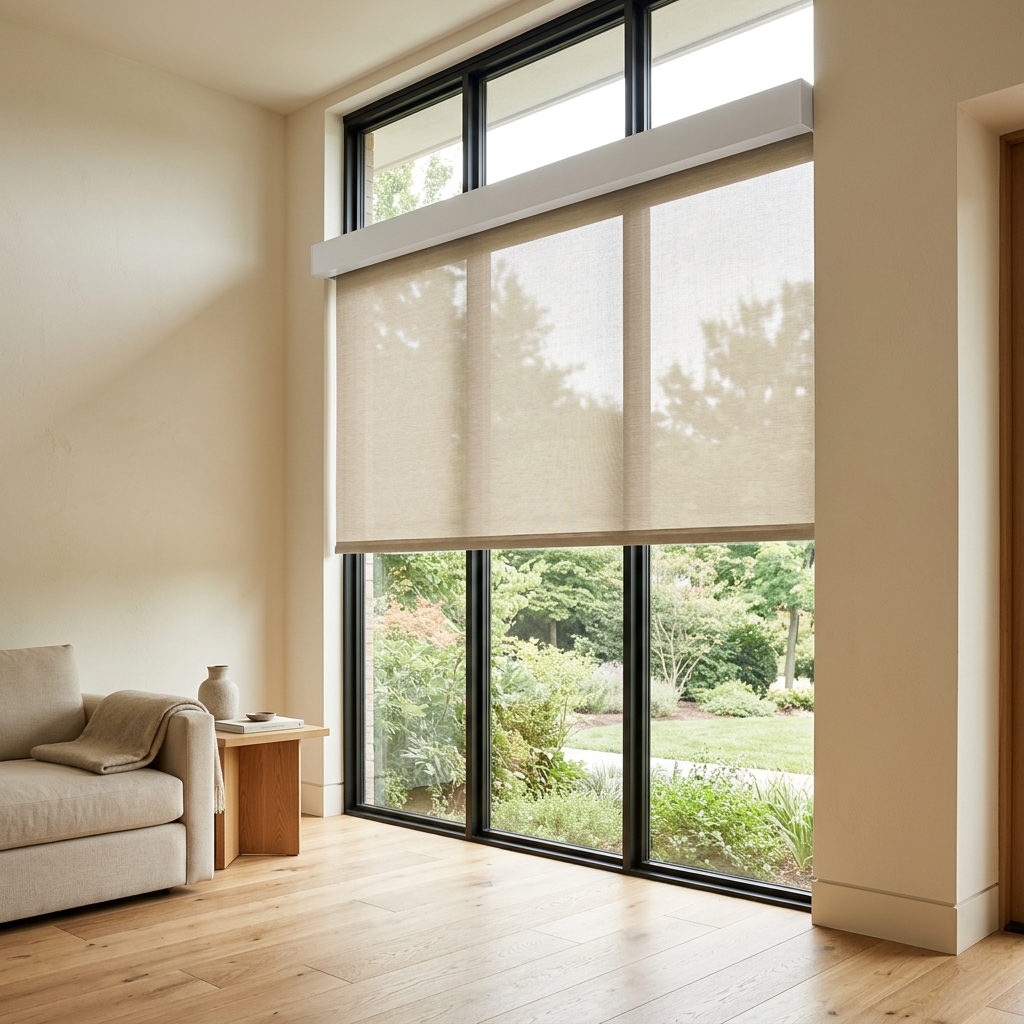
Side by Side
| Feature | Industry Standard | The Retreat Standard |
|---|---|---|
| Material Gauge | Thin, stamped (flexes/chatters) | Heavy-Gauge Architectural Aluminum |
| Component Fit | Floating / Friction-Fit (Rattles) | Mechanically Secured with Screws |
| Light Control | Visible gap above the cassette. | Integrated Brush Strip Seal |
| Bracket Construction | Standard gauge, prone to vibration and rattle | Heavy-gauge bracket engineered to eliminate rattle, with integrated child safety design built in |
| Motor Noise | Resonant mechanical buzz | Whisper-Quiet (Nylon & Silicone) |
| Wide Spans | “Smiley face” fabric sag | Reinforced Tube (Significantly Reduced Deflection) |
| Cordless Play | Fickle / Constant adjustment | Fail-Safe / Little to No Adjustment |
“If a customer is complaining about it, it is an engineering problem.”
The AERIS Engineering Standard
Program engineering
Problem 05
The industry standard roller shade spec guide runs 150+ pages, but most of it isn’t there for the reasons you’d think. Physical engineering constraints are real. Different cassette sizes hold different fabric capacities. Different lifting systems have different minimum and maximum dimensions. Those specs exist because the physics demand them, and they can’t be eliminated.
That’s not where the spec-guide problem lives.
The real problem is that most manufacturers then add fabric-specific exceptions on top of the physical specs. Fabric A has a different maximum width than fabric B. Fabric C has a different drop limit. Fabric D isn’t compatible with a certain motor. Once you start stacking fabric-level rules on top of system-level rules, a spec guide balloons to 150 pages and your salespeople can’t memorize any of it.
The fix: We standardized at the collection level. Every fabric in the Retreat sample book runs on the same spec as every other fabric in the book. Max width is max width. Height limits are height limits. Motor compatibility is consistent. We still have different specs for different cassette sizes, and different ranges for different lifting systems, because physics. But inside a collection, a fabric is a fabric. That single decision eliminated roughly 65 pages from a typical dealer spec guide. Your salespeople feel the difference on day one. Your office feels it on day two.
Problem 06
When a dealer orders a roller shade, most manufacturers take the ordered size and modify it before building. They call it a deduction. Every manufacturer has different ones. Every product has different ones. And the deductions aren’t built for ideal fit. They’re built to reduce service calls caused by dealers who can’t measure properly.
The reason that exists is because most manufacturers sell to DIY customers, online buyers, inexperienced dealers, and box stores. Deductions protect them from their least qualified customers. But if you know how to measure, those same deductions are working against you. You’re ordering one size and getting another.
The fix: AERIS has one rule on deductions. There are none. We build to your ordered size. That’s it. If you measured it, we build it. One rule means nothing to memorize, fewer pages in the spec guide, and a product that fits the opening the way you intended.
Where we are
Every product in our line is under active engineering. The fixes above are what we’ve built into Retreat so far. The next round is already in discussion, driven by what we see on our own retail jobs every day and by what dealers in the network tell us.
If you’re living with a roller shade problem that isn’t on this list, we want to hear about it. That’s how this works.
Every Retreat Series shade is backed by the AERIS Limited Lifetime Warranty.
The best way to understand what we built is to put a sample in your hand and pull the shade yourself. If you’re evaluating us, let’s get on a call.