Playbook
What Happens When You Actually Train Your Sales Team
We went from occasional training to three structured sessions a week. In 90 days, four of seven reps made massive jumps. Two more improved. One didn't. The training didn't just improve the team. It transformed it.
Most sales teams don't train. They meet. They review numbers from last month. They talk about what went wrong on a job. They put training on the calendar and fill the time with administrative work. Then everyone goes back to running appointments the same way they ran them yesterday.
We were close to that. For about eighteen months, I had stepped away from the sales team to focus on other parts of the business. When I finally returned, I found out that training wasn't scheduled. It happened occasionally, but it wasn't weekly, it wasn't structured, and it wasn't building on anything. Group skill work had faded out. One-on-one coaching was gone. The only consistent touchpoint was a monthly KPI review that looked backward at what had already happened. Nobody was teaching anyone how to sell better. Nobody was working on the craft.
The person in the sales leadership seat had come from a large corporation where the business was already built. Her previous role had been administrative over a big team. Keeping things organized. Managing the machine. That's a real skill, but it's a different job than growing a small sales team. In a small business, the sales leader's job is to make the people better. If they're not doing that, nothing else they're doing matters.
We had four straight months of declining revenue. Close rates were slipping. Ticket sizes were falling. The team had started to believe that a $100,000 month was a big deal.
It wasn't.
The Reset
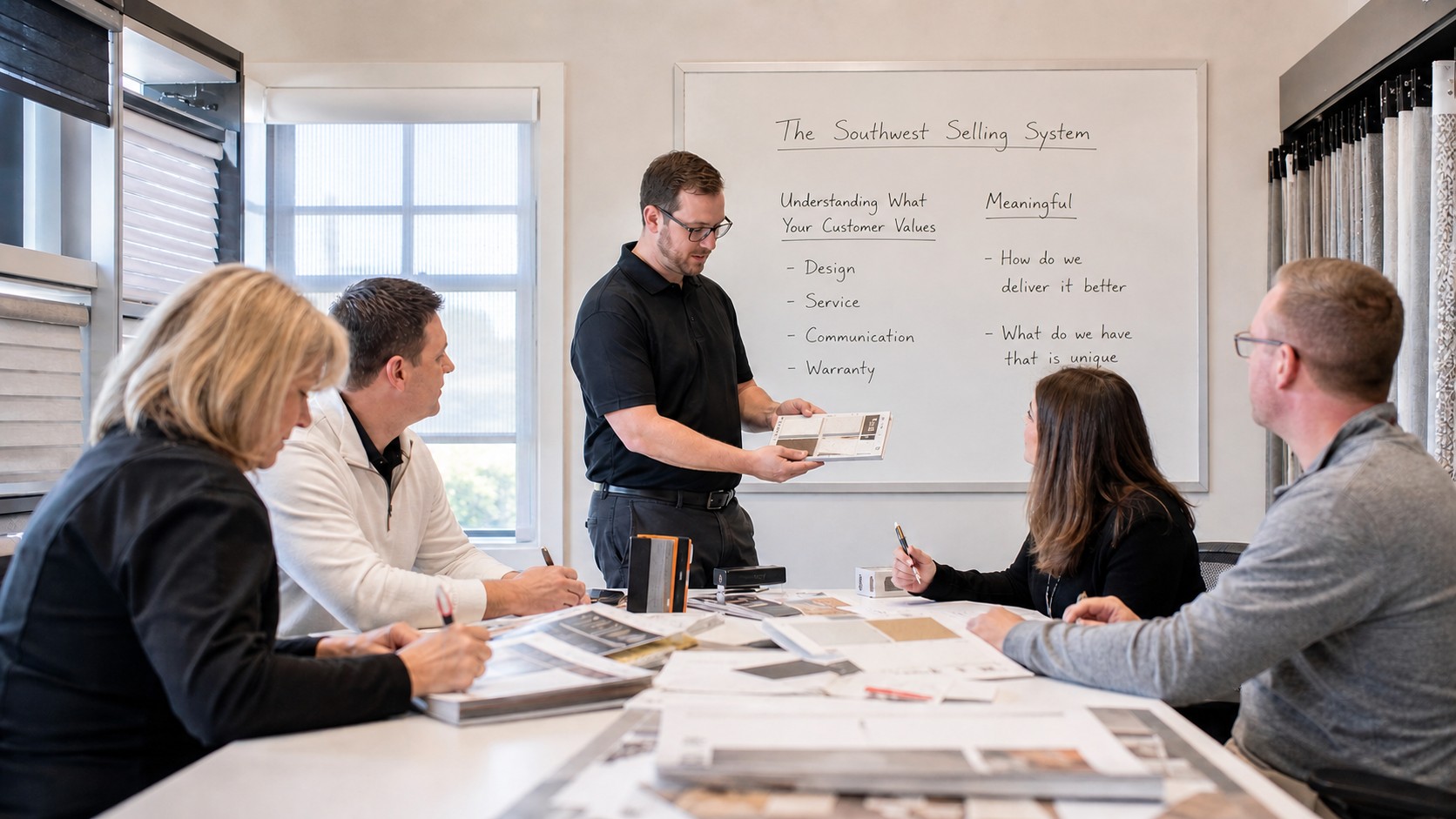
When I returned, we restructured everything. We held mandatory sales training three mornings a week, from 8:30 to 9:30, on video. We went back to the very beginning of our selling system and started training each concept from scratch. Not a quick review. Real depth. We'd take a single topic, discuss it, roleplay it, challenge people to implement it in their next appointments, and then come back and share what happened. We'd stay on a concept for days until the team could execute it, not just explain it.
We started using Rilla, a virtual ride-along tool that records and analyzes sales conversations. It had been available to the team for almost eighteen months, but nobody was using it. Not the reps. Not the managers. We changed that. Everyone started listening to their own recordings and taking notes, tagging each other, and we reviewed them together as a group. The reps started hearing themselves, and that alone changed how they showed up on the next appointment.
The training was consistent, skills-based, and relentless. No admin. No fire drills. No reviewing last month's numbers. Just getting better at selling.
Intensity matters. Occasional training produces occasional results. When you train three times a week and every session is focused on skill development, the reps don't just learn the material. They internalize it. It changes the way they walk into a room.
What Happened to the Top Producers
Before the training reset, our top reps were statistically on par with good salespeople in our industry. They were solid, professional, and doing fine. They sold $100k to $125k a month.
Ninety days later, four of them had jumped to elite.
Our top rep grew 148 percent in three months compared to the same three months a year earlier. She didn't go from bad to good. She went from good to exceptional. Three other reps made similar jumps, all above 24 percent growth over the same three-month window a year earlier. They started chasing $200,000 and $300,000 months. They got excited about higher-level skills. They were closing more, earning more, and enjoying the work more.
That's what real training does to A players. It doesn't rescue them. It unlocks what was already there. They want to get better. They'll do the work. They just need someone pouring into them consistently, and most of the time, nobody is.
What Happened to Everyone Else
Same training. Same schedule. Same system. Same accountability. Different results.
We compared every rep's performance from February through April 2026 against the exact same three months in 2025. Reps who were new to the team were excluded. Here's what the data showed across the seven who were in both periods.
| Rep | Growth vs. Same Period Prior Year |
|---|---|
| Rep 1 | ↑+148% |
| Rep 2 | ↑+45% |
| Rep 3 | ↑+37% |
| Rep 4 | ↑+24% |
| Rep 5 | ↑+10% |
| Rep 6 | ↑+3% |
| Rep 7 | ↓-11% |
Four reps with massive gains. Two with real improvement. One declining.
We also had to let a rep go during this stretch. They showed up to the training sessions but wouldn't complete the assignments. Wouldn't study their Rilla recordings. Wouldn't attempt the skills in the home. They did the minimum of being present and none of the actual work. The elevated training didn't just reveal their skill level. It revealed their commitment.
The top group grabbed the training and ran with it. The two in the middle improved, which means the training was reaching them, but the gap between improving and transforming is visible in the numbers. One person went backward across every measurement window. And one person showed us they weren't willing to do the work at all.
That's not a failure of the training. That's the training doing exactly what it's supposed to do. It separates your team into tiers you can see clearly. A players improve fast. Middle performers show you where the ceiling might be. And the people who aren't going to make it stop being hidden by the noise of daily business.
That's information most owners never get because they never build the system that would surface it.
The Job of a Sales Leader
This article isn't about one bad hire or one bad stretch. It's about what the sales leadership role actually is.
Our Director of Sales was organized. She was detail-oriented. She paid close attention to every job. She supported the reps with paperwork and process. She was doing a lot of work, and she was doing it well. But the work she was doing wasn't the job.
The job of a sales leader is to grow the people. Teach them how to sell better. Push them past where they're comfortable. Pour into them with real effort, consistently, not once a month over a KPI spreadsheet. If a sales leader isn't doing that, the team flatlines. It doesn't matter how organized the operation is or how clean the spreadsheets look. If nobody is working on the craft, the craft doesn't improve.
When we started training with intensity, the business responded in weeks. Not months. Weeks. The top producers were ready. They had been ready. They just needed someone to show up and invest in their development every single day.
The Real Point
Most of us run our days the same way. Same routines. Same appointments. Same conversations. And we get the same results. That's true in sales. It's true in operations. It's true in every part of a business.
Time to work on the craft matters, and most of us aren't spending any.
When you commit to real training, multiple times a week, structured, skills-based, and relentless, two things happen. The people who want to be great get great fast. And the people who were hiding in the routine get exposed.
Both of those are wins. One grows your business. The other tells you where to focus next.
If your sales team has plateaued and everyone is just running appointments and following the same routine, the answer isn't more leads. It's not a new CRM. It's not a better comp plan. It's training. Real training. Consistent training. The kind where you work on one skill until the team can do it in their sleep, and then you move to the next one.
Give your team 90 days of it and watch what happens. The results will tell you everything you need to know.