Playbook
Unique and Meaningful
After firing a salesperson and taking over his appointments in California, I broke every sales record on the team in a single week. The flight home kicked off a years-long project: figuring out what fifteen experienced salespeople were missing, even though they were running the same playbook everyone else in the industry runs.
The Week I Took Over the Appointments
I had to fire one of my salespeople in California. He covered a territory that had always struggled. Not just for us. The territory had been a low performer for the box store itself, one of the worst in the region for years. And he was the only rep we had within three hours of it. There was no easy handoff. I got on a plane the next day, took over his appointments, and started interviewing his replacement at the same time.
I hadn't been in a customer's home selling in years. I had never sold in that territory at all. The only box store appointments I had ever run were a handful from the very beginning of the program, years earlier, and that had been a few leads, not a real week of work.
This was a full calendar. Five days of back-to-back appointments. A real representation of what that territory looked like every week.
I broke every sales record we had in that territory. In one week, I sold more than the team had ever sold there in a month.
I want to be careful about how I say that, because it would be easy to read it as the owner shows up and shows the team how it's done. That's not what this article is. What struck me, on the flight home, was something else. Those had been the easiest sales I had ever done. In a territory that was supposed to be one of the worst. The leads were warm. The customers were motivated. They wanted to say yes. And none of that was reflected in what was happening across the rest of the company. I had fifteen salespeople working for me, many of them experienced window covering people, and the close rates on the same kind of leads were nowhere near what I had just experienced for a week.
Something was wrong. The leads weren't the problem. The territory wasn't the problem, even though everyone had been telling themselves it was for years. The product wasn't the problem. The people selling for me weren't the problem in any way I could point to, because they were experienced and they were working the process. But something between those warm, motivated customers and our quoted jobs was breaking down, and I didn't yet know what it was.
That flight home is what kicked off the work I've been doing on this for the last several years.
What I Found When I Got Home
The first thing I did when I got back was sit down with every salesperson on my team and walk through their process with them. Not in a meeting. One on one. I had them describe what they actually did from the moment they pulled up to a house to the moment they left.
Every one of them described roughly the same thing. They built rapport at the door. They did a home tour, walking through the rooms with the customer, getting a feel for the house. They learned about how the family lived, what bothered them about the existing windows, what they were hoping to fix. They demoed product. They measured. They presented the quote. They tried to close.
I've interviewed over a hundred salespeople across my career, in my own company and during hiring. Almost every one of them ran a version of that same process. Rapport, tour, discovery, demo, measure, quote, close. That's the playbook in this industry. It's also, near as I can tell, the playbook in most home services trades.
My team wasn't doing anything wrong. They were doing exactly what they had been taught and what every other company seemed to be doing.
That's what made the puzzle harder. If everyone was running the same playbook, the answer wasn't going to be in the playbook.
The Process Isn't the Problem
I want to be clear about something, because this is where I see a lot of operators get the wrong lesson.
The process isn't the problem. Rapport matters. The home tour matters. Demoing the product matters. Measuring matters. Presenting a clean quote matters. If you skip those steps, you have a worse sales call, not a better one.
The process is fine. The process has been fine for decades. The reason it produces average results across an entire industry is not that anyone is executing it poorly. It's that the process is built around the wrong question.
Every step in the standard playbook is oriented toward the product. Rapport so the customer trusts you to recommend product. Home tour so you can see where product needs to go. Discovery so you understand which product fits their life. Demo so they can touch the product. Measure so you can quote the product. Present so you can sell the product. Close so they buy the product.
The whole process is asking, what product does this house need. And then walking the customer through a sequence designed to deliver that answer.
That's the problem. Not that the steps are wrong. That the question underneath the steps is wrong.
What the Homeowner Is Actually Buying
Here is what I figured out on that flight home, and what I've spent years confirming since.
The homeowner is not buying a product. They have already decided they want window coverings before you walked in. The decision they're making in front of you is not which product. It's which company.
What they actually want is the hope that the company they hire is going to do this right. They want somebody who will show up when they said they would. Communicate. Treat them and their home with care. Deliver quality workmanship. Finish on time. Stand behind the work if something goes wrong. Deliver what was promised, without the customer having to chase them down to make it happen.
That's what they're buying. The product is one piece of the outcome. It is, in most cases, the smallest piece. We are all selling the same products anyway. The fabrics come from the same mills. The mechanisms come from the same factories. The warranties read almost identically. A homeowner can get the same shade from any of three or four dealers in their market. What they cannot get from every dealer is the assurance that the company they're hiring is going to handle them well.
The pain underneath this purchase is the pain of hiring contractors.
Every homeowner who has lived in a house for more than a few years has a story about a contractor who didn't show, didn't communicate, didn't deliver, or disappeared when something went wrong. That story is sitting in the back of their head when you walk in. They are not telling you about it. You have to find it.
That's the sale. Helping the homeowner believe, with real evidence, that hiring you is going to be different from the last time they hired somebody to work on their home.
What I Was Actually Doing
When I went back through the California week, what I had been doing differently wasn't a step. It was a focus.
I had spent a lot of time, much more than my team typically did, asking about them. Not about their windows. About their history. What other work had they hired done on the house. How had that gone. What had they liked about the companies they had worked with. What had frustrated them. Why had they decided to do this project now. What were they worried about.
By the time I sat down to present, I knew things about that customer that had nothing to do with shade selection. I knew what they were afraid of. I knew what had gone wrong the last time they hired somebody. I knew what they valued in a company, in their own words, because they had told me.
And then, when it was time to present, I didn't lead with product. I told them a story about how we solved the thing they were worried about. How our install process worked. How we communicated. What we did when something went wrong. Why a homeowner could feel safe having our crew in their house. Why we ran the company the way we did.
That conversation usually went on for fifteen to thirty minutes. It was a back and forth, not a pitch. They asked questions. I asked questions back. We talked about things they had not expected to talk about when they sat down at the table. By the time we got to the actual product and the actual quote, something had shifted. They weren't comparing me to other dealers anymore. They felt like they had found something they couldn't get somewhere else.
Price objections, almost all of them, evaporated. Not because the price was lower. The price was always higher than what the other companies were quoting. The price stopped being the conversation because the conversation had moved somewhere else.
That's unique and meaningful. Something they value, something we genuinely do differently, connected to them in a way that feels personal. When all three pieces are present, you have a sale that nobody else in the market can match.
Where I See It Break Down
Once I understood what I was looking for, the failure modes were everywhere. Three of them, mostly.
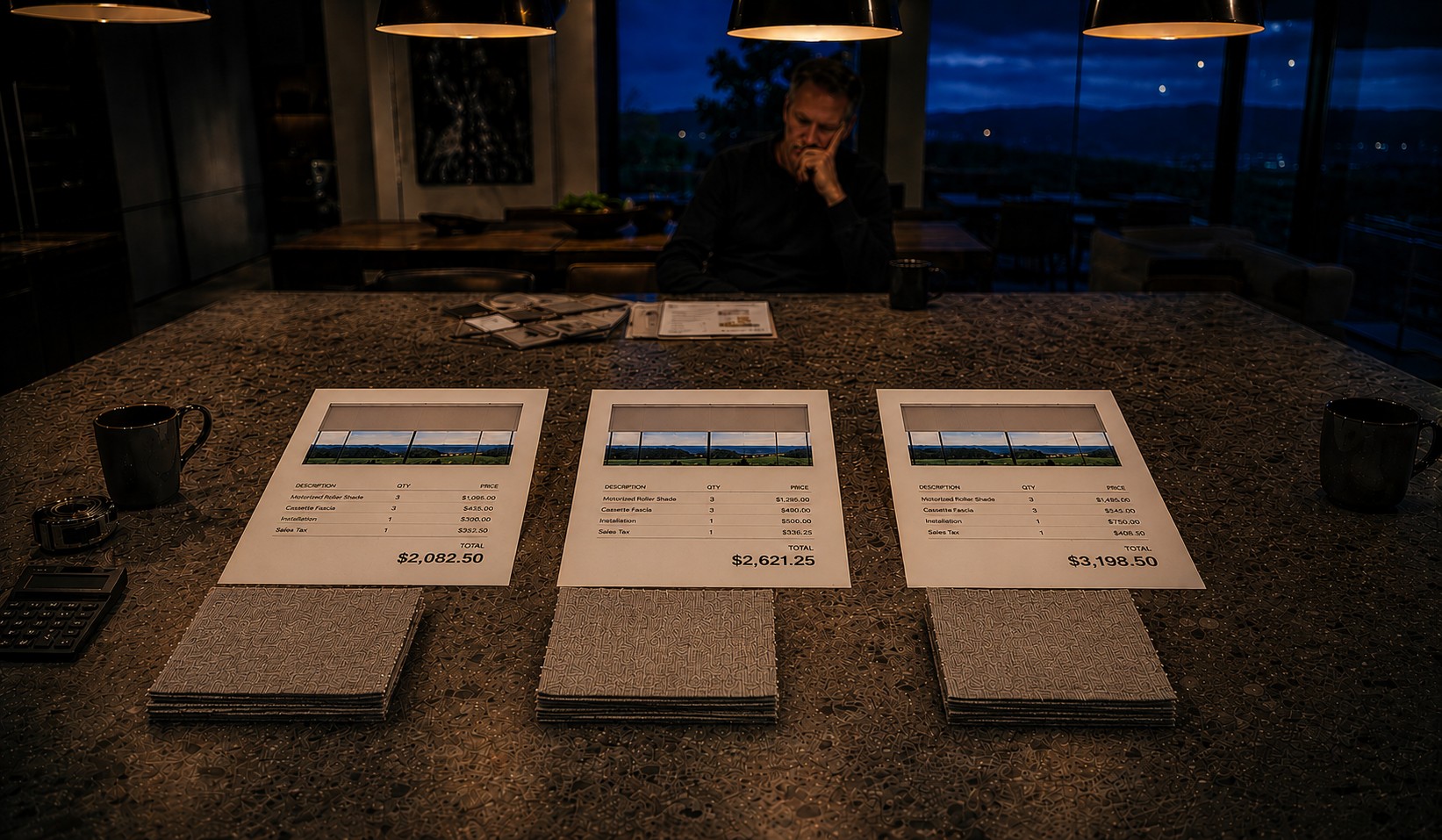
The first is quoting too fast. The salesperson treats the appointment as a quoting exercise. Get in, measure, hand over a number, get out. The whole conversation that would have surfaced what the homeowner actually wants never happens. The quote arrives in a vacuum, and the only thing the homeowner has to evaluate it against is the price from the dealer who quoted them last week.
The second is product focus. The salesperson treats the whole appointment as a product conversation. What fabric, what lift system, what color, what stack height. The customer ends up with a lot of information about the product and very little reason to choose your company over the one down the road that sells the same product.
The third is educator mode, and it's the worst version of product focus. The salesperson turns into a teacher. They give the customer a tour of the entire product line. They explain how cordless cellulars are built. They walk through fabric weaves and openness factors. They demonstrate every option in the bag. The customer leaves the appointment with a graduate seminar in window coverings and no clear sense of who they should hire.
All three failure modes have the same root. The salesperson is staying on the surface of the sale, where the product lives, instead of going underneath it, where the homeowner actually is.
The Close Rate Trap
Before any of this lands for an operator, there's something worth being honest about.
Some dealers point to their close rate as a gold star. Sixty percent. Seventy. Higher. And it sounds impressive until you look at what's underneath it. Most of the time, a high close rate is not a sign of sales skill. It's a sign of one of two things, or both. The business is running mostly on referral and repeat customers, who walked in already sold before the salesperson said a word. Or the business is pricing competitively, sometimes aggressively, sometimes below where the math says it should be, in order to keep deals from walking.
Both of those produce close rates that look great on a report. Neither of them tells you anything about whether your team can actually sell.
The real gold star is a different number. It's the close rate on cold, advertised leads, at prices meaningfully higher than the rest of your market. That's the test. That's when you find out what the sales skill is actually worth. A salesperson who can take a lead off a paid ad, walk into a house cold, and close that customer at a higher price than the dealer down the road is doing something almost nobody in this industry is doing. That is the skill. That is what unique and meaningful is for.
If you're running on referrals and repeats and you like the business you have, that's a real business. I'm not knocking it. But it's a slow growth business, and it's a business that's vulnerable the day the referrals slow down or the long-term customers stop calling. You don't get to scale it past a certain point because the only fuel you have is goodwill you already earned years ago.
If you want to run a business that can grow on its own engine, you have to be able to do two things. Charge more than your market. And close cold leads at that higher price. Most dealers struggle to do either one. The ones who can are the ones who took the work in this article seriously.
So before you decide whether any of this applies to you, ask yourself which business you're actually in.
Why I've Spent Years on This
I have spent years working with my team on this. We call it unique and meaningful, and it's harder to teach than almost anything else in the sales process.
It's harder because it can't be scripted. You can't hand a salesperson a list of questions and tell them to run through it. The conversations that produce unique and meaningful sales are real conversations. They go where the customer takes them. The salesperson's job is to listen carefully enough to hear what the customer is actually telling them, and then to build a presentation that connects what the company does to what the customer just said matters.
The salespeople who can do this consistently are rare. Some of mine have picked it up. Some never have, no matter how many times we've worked through it. The ones who struggle tend to be the ones who came up in a part of the industry where the playbook was the whole job. They know how to run the steps. They struggle to do the thing underneath the steps, because the thing underneath the steps was never named where they learned to sell.
I don't think this is an industry problem we're going to solve at the industry level. I think it's a problem each operator solves inside their own company, slowly, over years, with the salespeople they have and the salespeople they hire. I'm still working on it. I'll keep writing about it as the work continues.